The three-channel system to grow your music school's enrollment
The fastest way to grow enrolment is to build one repeatable system instead of chasing a dozen scattered tactics: combine local SEO, a referral programme and community partnerships, then feed every enquiry through a conversion-focused intake process. Start today by claiming your Google Business Profile and setting up a simple taster lesson sign-up form. Everything below gives you the step-by-step tools to build the rest.
TL;DR:
Claiming and optimizing your Google Business Profile provides the most passive local demand insight with minimal effort and cost.
Layering in referrals and community outreach only after establishing local SEO ensures steady growth without overwhelming your intake system.
For small ad campaigns, start with low budgets of £5-10 a day focused on quick, simple lead capture and respond within five minutes to maximize conversion.
Building a structured onboarding process and ongoing referral system significantly improves student retention and lifetime value.
Measure and improve enrollment efforts weekly by focusing on campaigns with direct booking results rather than just clicks or inquiries.
Musicteacherpros
Build A Steadier Enrollment System
Music Teacher Pros helps educators attract students with automated marketing, customized tools, and lead capture systems built for music businesses.
Table of Contents
How to build a three-channel system: local SEO, referrals and community partnerships
Paid ads and lead funnels that convert enquiries into students
Retention and onboarding: turn a trial into a long-term student and an ambassador
Quarterly marketing calendar and 10 quick wins you can implement this week
Author perspective: why a system matters and how to start small
How to build a three-channel system: local SEO, referrals and community partnerships
Most teachers treat marketing like a grab bag: a flyer here, a Facebook post there, maybe a discount code nobody uses.
That scattergun approach feels productive but rarely compounds. Three-focused channels, run consistently, beat fifteen half-finished ones because each one builds on the last: local SEO brings people who are already searching, referrals bring people who already trust you, and community partnerships put your name in front of people before they even start looking.
Here’s how to set up each one without hiring an agency.
Local SEO checklist:
Claim and fully complete your Google Business Profile, including photos, opening hours and your lesson types.
List your studio in two or three relevant local directories; claiming and optimising directory listings properly is the part most teachers skip.
Add your business name, address and phone number consistently across your website and every listing.
Build a simple review request into your intake process and manage incoming reviews with a tool built for the job, since review management software makes this far less fiddly than chasing reviews manually.
Make sure your website states clearly, on the homepage, what instruments you teach and where.
Referral system basics:
Ask every happy parent or adult student directly, using a simple script: “We grow mostly through word of mouth. Do you know anyone who’d love lessons?”
Offer a small, concrete incentive (a free lesson, a month’s credit) for both the referrer and the new student.
Create one “ambassador” tier for your most engaged families who refer repeatedly, with a slightly bigger reward.
Community partnerships:
Approach local primary schools and offer a free lunchtime demo or taster session for their music club.
Contact music shops about leaving your cards at the till or running a joint demo day.
Reach out to libraries and youth groups with a simple pitch: a free 15-minute “meet the instrument” session in exchange for being listed in their newsletter.
Resource these in sequence rather than all at once.
Spend your first month getting local SEO solid, since it works passively once it’s live. Layer in referrals during month two, when you have a few happy students to ask. Add community outreach in month three, once your intake process can handle the extra enquiries.
Track three numbers: enquiries per channel, enquiry-to-trial conversion, and trial-to-enrolment conversion.
Pro Tip: Ask for the review the day after a great lesson, not weeks later. Warmth fades fast, but a quick text with a direct link gets you a far higher response rate.
Paid ads and lead funnels that convert enquiries into students
Paid ads only pay off if the funnel behind them is solid. Lead generation campaigns (where someone fills out a form without leaving Facebook or Instagram) tend to outperform traffic campaigns for music lessons, because parents browsing on their phones rarely click through to a separate website. Use traffic campaigns once you have a genuinely fast, mobile-friendly booking page worth sending people to.
A few campaign ideas that work reliably for small studios:
A “free taster lesson” offer timed to the start of a school term.
A seasonal open-day promotion built around a concert or recital.
A group class enrolment push for beginners, priced lower than private lessons to reduce the decision barrier.
Your landing page needs to do one job: capture a name, phone number and preferred instrument in under 30 seconds.
Every extra field drops your conversion rate. Cut anything you don’t need for the first phone call, and understanding the difference between Google display and search campaigns helps you decide whether to chase clicks or build awareness first.
Follow-up speed matters more than most teachers assume.
Respond to a new lead within five minutes by text if you can, since even a short automated reply that says “thanks, we’ll call you shortly” keeps the lead warm. If you miss a call, a system that automatically sends a missed call text back can recover enquiries you’d otherwise lose entirely.
Follow the text with a short phone call using a simple script: confirm the instrument and age of the student, offer two specific time slots for a trial, and book it there and then rather than leaving it open-ended.

For budget, start small: £5 to £10 a day is enough to test a taster lesson offer in a single postcode area.
Run it for two weeks, check your cost per enquiry, and only scale the campaigns that produce bookings, not just clicks. Understanding campaign budget optimisation versus ad set budget optimisation becomes useful once you’re running more than one ad set at a time.
Pro Tip: Whoever answers the phone or replies to the form is your highest-leverage marketing asset. Train that script before you spend another pound on ads.
Retention and onboarding: turn a trial into a long-term student and an ambassador
A new student’s first 30 days decide whether they stay for a term or a year. Build a simple onboarding flow:
Send a welcome email within 24 hours confirming the schedule, what to bring and what to expect from the first lesson.
Set expectations early: how progress is measured, how often you’ll communicate with parents, and what practice looks like at home.
Give a simple one-page practice plan after lesson one so students have a concrete next step, not just vague encouragement.
Check in personally after the second and fourth lessons to catch hesitation before it becomes a cancellation.
Seasonal drop-off is one of the biggest killers of enrolment.
A short summer bridge programme, even just a once-a-month group session or a recorded practice challenge, keeps students connected and makes September re-enrolment far more likely than starting the search from scratch each autumn.
Your best new students often come from your current ones, which is why the referral system from earlier needs to run continuously, not as a one-off push. Offer account credit rather than cash wherever possible, since it keeps the value inside your business and encourages longer-term engagement.
A small tiered system (one credit for a referral, a bigger reward for three in a year) keeps motivated families engaged without becoming a bookkeeping headache.
Track a simple monthly retention rate (students retained divided by students enrolled at the start of the month) and watch it over a few terms. If you want a rough proxy for lifetime value, multiply your average lesson price by the average number of months a student stays.
Small experiments, like changing your check-in timing or adding a practice plan, let you see what actually moves that number rather than guessing.
Pro Tip: A five-minute check-in call after lesson two catches more at-risk students than any email sequence ever will.
Quarterly marketing calendar and 10 quick wins you can implement this week
Enrolment follows the school calendar, so your marketing should too. Treat each quarter differently:
Late summer to early autumn: your biggest recruitment window, tied to new school terms; push local SEO and community partnerships hardest here.
Winter: lean on referrals and festive concerts as a natural showcase for new enquiries.
Spring: run a taster campaign ahead of summer term sign-ups and prepare your bridge programme messaging.
Early summer: promote holiday workshops and lock in September renewals before students drift away.
Ten quick wins you can action this week:
Claim and complete your Google Business Profile if you haven’t already.
Add a referral card to your next concert programme.
Run one small boosted Facebook post for a taster lesson in your local area.
Partner with a nearby music shop for a joint demo day.
Ask three recent students for a Google review today.
Add a clear “Book a trial lesson” button to your website’s homepage.
Set up a simple missed-call text-back message.
E-mail your current student list asking for referrals, with a specific incentive attached.
List your studio on one new local directory.
Draft a one-paragraph outreach script for a local school’s music department.
Measure results weekly rather than monthly while you’re testing.
If a quick win produces even one enquiry, repeat it the following week before moving to the next idea. Scale only what you can point to a direct booking from, and shelve the rest without guilt.
Author perspective: why a system matters and how to start small
The biggest mistake I see is effort spread so thin that nothing gets a fair test.
A teacher tries Instagram for a week, gives up, tries flyers, gives up, and never finds out what actually works because nothing ran long enough to produce data.
The second biggest mistake is obsessing over lead volume while ignoring intake. More enquiries mean nothing if half of them never get a call back.

Scaling from one teacher to a multi-teacher school just means the same system runs on repeat, with someone accountable for intake and follow-up as a dedicated role rather than an afterthought.
If you do one thing after reading this, make it a single experiment: claim your Google Business Profile properly and track enquiries from it for four weeks. It costs nothing, takes an afternoon, and tells you more about your local demand than any amount of guessing.
Treat enrolment like a system you tune, not a mystery you solve.
— Liam
How Music Teacher Pros maps to this plan
Everything in this article works better with the right infrastructure behind it, which is exactly what we built the All-In-One Marketing System to provide.
Our platform offers Facebook and Google ad campaigns templates, an SEO-friendly website framework aimed at converting enquiries, and lead capture with automated follow-up to help manage enquiries effectively.
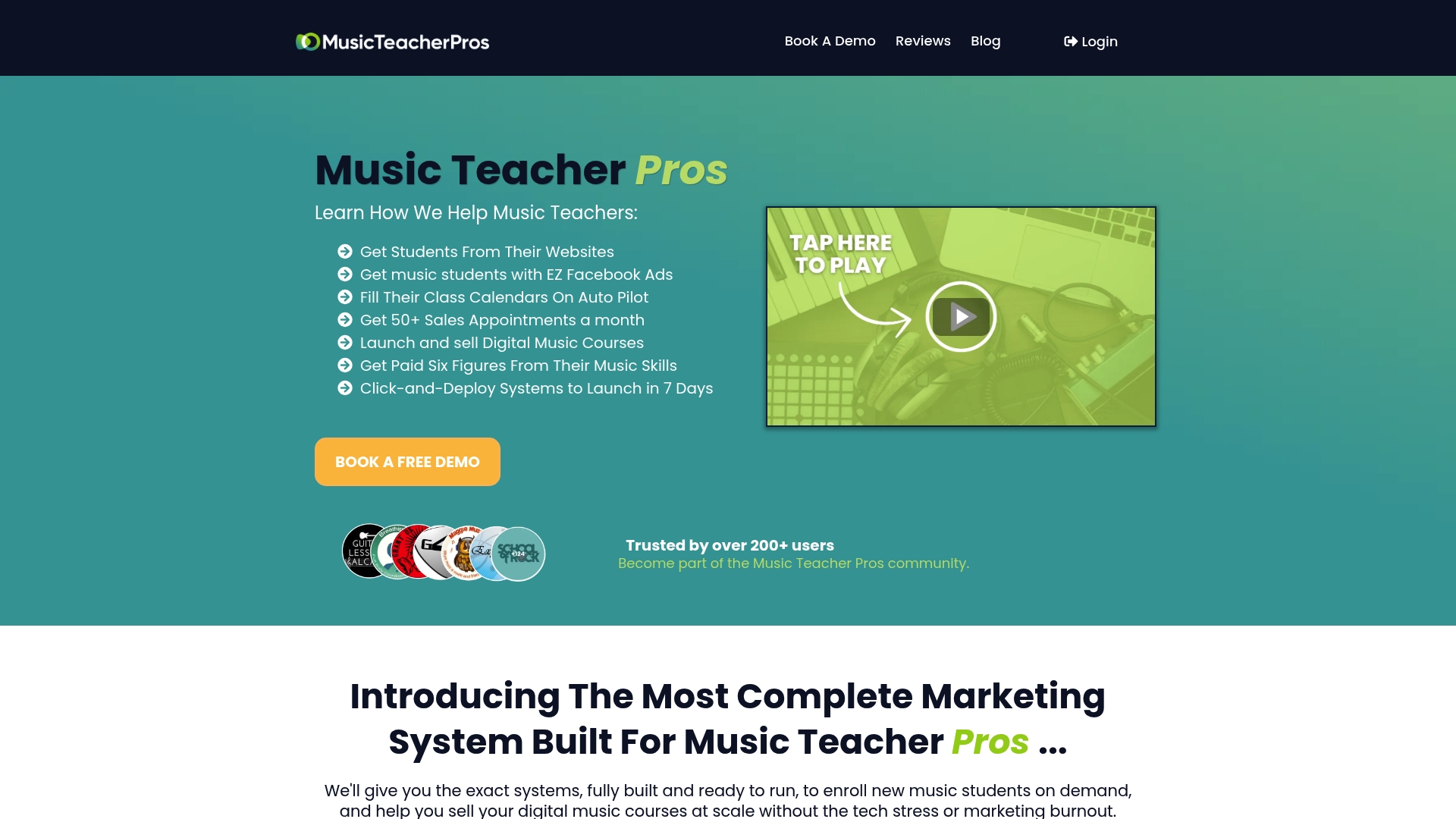
We built this because most music teachers didn’t train to become marketers, and shouldn’t have to become them just to keep a full class list.
Our automations handle tasks like ad setup, follow-up texts, and booking pages, while coaching and community support help you apply the three-channel system to your local context and instrument mix.
If you’d rather spend that time teaching than wrestling with ad managers and website builders, take a look at Music Teacher Pros and see how it fits your studio.
FAQ
Is there a shortage of secondary school music teachers?
Teacher supply pressures vary significantly by country and depend heavily on local policy and demographics, according to OECD analysis.
In England specifically, a parliamentary committee report has highlighted persistent teacher vacancy rates and noted that central recruitment budgets alone have not resolved them.
How much is a 30 minute music lesson?
Rates vary by setting and region, so there’s no single universal figure, but UK data gives a useful benchmark.
The 2026 ISM fees survey reports median hourly rates of £36 in state-funded schools, £38.23 in independent schools and £43.80 in specialist music schools, with the Musicians’ Union recommending a minimum hourly rate of £45.50 for self-employed teachers for 2026 to 2027.
How old do you have to be to go to music school?
Entry ages depend entirely on the type of music school and its own admissions policy, since some accept young children for foundational lessons while specialist conservatoires set much higher age and ability thresholds.
There’s no single universal minimum age, so it’s worth checking admissions criteria directly with any specific institution you’re considering.
How much does a secondary school music teacher earn?
Teacher pay depends on country, school type and experience level, and no single figure applies universally across education systems.
The ISM fees survey and the OECD’s teacher supply analysis both illustrate how pay and recruitment pressures differ sharply between settings and countries.
Sources
These sources back the figures and context used throughout this article, and they’re worth a closer read if you want the fuller picture.