Fill Lesson Seats: Ad Copy for Music Teachers with 7–11 Word Headlines
Fill Lesson Seats: Ad Copy for Music Teachers with 7–11 Word Headlines
The most effective ad copy for music lessons makes one clear promise to parents in the headline, backs it with short benefit bullets, and asks for one tracked action.
Every winning ad, whether it runs on Meta or Google, needs three parts working together: a visual that stops the audience scrolling, bullets that answer parents’ or adult students' worries, and a call to action that leads to a calendar or a contact form where you can collect their details.
TL;DR:
Most parents care about the atmosphere, enjoyment, and teachers' warmth over price when choosing music lessons, so make sure to mention this in your ad headline.
Add the promise up front: let them see what they will get, and list the quick wins. For example, mention the safety, progress, and flexibility.
Testing multiple persona, angle, and offer combinations on Meta and Google is essential for optimizing ad performance, with a focus on click-through and conversion rates.
Localizing ad copy with geographic references, bilingual messaging, and tailored framing increases relevance and engagement within different communities.
Social proof like short testimonials and review ratings significantly boost trust and clickability, especially when videos or direct parent quotes are used.
Musicteacherpros
musicteacherpros.com
Fill More Lesson Seats With Better Marketing
Music Teacher Pros combines ad campaigns, SEO websites, and lead capture systems to help music teachers attract more students.
Table of Contents
Core elements of ad copy for music lessons that actually converts
A repeatable framework for testing ad copy for music lessons
Ready-to-use headline and CTA templates for music lesson ads
Tailoring ad copy to instrumental, vocal, group, and private lessons
Why this ad-copy approach actually fits how music teachers work
Core elements of ad copy for music lessons that actually converts
Most music teachers write ads the way they’d write a lesson plan: thorough, well-meaning, and far too long.
But ad copy for music lessons works the opposite way...
...it has to do a lot of convincing in very little space, so every part of the ad has a job.
Meta’s static creatives tend to follow an 8-part anatomy: visual, headline, sub-headline, benefit bullets, call to action, branding, a scarcity cue, and a pricing or offer detail.
Skip one and the ad feels thin, but if you cram all eight in badly, it'll feel cluttered.
The headline carries the most weight of any element, since people read headlines far more than body copy, so that’s where your best sentence belongs, not buried in paragraph three.
For headlines, use the Feature→Benefit→Meaning ladder.
State what you offer, what it does for the reader, and what that actually means for their life. Aim for 7 to 11 words.
“Weekly piano lessons that build real confidence” works better than “Learn piano with us.”
Headline: one promise, one benefit, 7 to 11 words
Benefit bullets: 3 to 4 lines, each answering a parent’s actual question (safety, progress, flexibility)
CTA: a specific verb tied to a specific action, not a vague “learn more”
Trust signal: a review count, years teaching, or a recognisable local landmark
Pro Tip: Write your bullets as answers to questions parents actually type into Google, not as a list of your qualifications. “Flexible evening slots for busy families” beats “10 years of teaching experience” every time.
Platform-specific asset rules for Meta and Google ads
Meta and Google reward different things, and copy written for one rarely performs on the other without adjustment.
On Meta, you’re working with the static ad anatomy described above.
The visual does the initial stopping power, but the headline decides whether someone reads on.
Meta’s format also rewards volume: rather than writing one perfect ad, build several avatar, angle, and offer versions and let the data tell you which combination performs best.
The benefits for the “parent of a nervous 7-year-old” persona could involve a “confidence-building” angle, while the “adult beginner” persona needs a “no pressure, no exams” angle.
On Google, responsive search ads work on a different logic entirely.
Google’s own guidance recommends supplying many unique headlines and descriptions, then letting Smart Bidding find the best combination for each search query.
In practice, aim for 8 to 10 headlines minimum and at least two descriptions, pin only the one or two lines that must appear (for example, your brand name), and leave the rest to rotate freely.
Writing genuinely resonant ad copy that mirrors what people search for still beats clever wordplay, on either platform.
What do parents actually want to hear in a music lesson ad?
Most music teachers mistakenly lead with price, when parents may not be looking at it at all.
Research into how urban parents choose music schools found that atmosphere, enjoyment, and the teacher-student relationship consistently score higher than cost when families make their decision.
Different personas need different hooks:
Parents of young children: lead with warmth and safety, not technical rigour. “A patient teacher who makes lessons something to look forward to.”
Parents of teens: lead with progress and independence. “Real skill development your teenager will actually stick with.”
Adult learners: lead with low pressure and flexibility. “Piano lessons on your schedule, no judgement, no exams.”
Make sure to list short proof points rather than long feature lists.
A one-line trial outcome (“Most students play their first song within three lessons”) does more than a paragraph about your grading credentials.
Pro Tip: Address the anxiety behind the enquiry, not just the enquiry itself. Parents aren’t really asking “do you teach guitar”, they’re asking “will my child stick with this and enjoy it”.
Bullets should answer the concerns parents actually carry: is it safe, will you tell me how they’re progressing, and can you work around football practice and school pickup.
A repeatable framework for testing ad copy for music lessons
Guesswork wastes budget, so let's have a structured testing workflow.
Build your matrix. Combine Persona × Angle × Offer to generate dozens of concepts from one core service. For music teachers, personas typically split into parent of a beginner, parent of an advancing student, and adult learner.
Run a minimum viable test cell. Give each concept enough spend to reach a meaningful sample before judging it, rather than killing ads after a handful of clicks.
Watch three numbers in order: click-through rate tells you if the hook works, conversion rate tells you if the offer works, cost per lead tells you if the maths works.
Apply stop or scale rules. Kill anything underperforming your average CTR after a fair test window; scale winners gradually rather than doubling budget overnight, which triggers the algorithm to relearn and often costs you performance.
Rotate creative before fatigue sets in. Falling CTR on a previously strong ad usually means the audience has seen it too often, not that the offer stopped working.
Ready-to-use headline and CTA templates for music lesson ads
Adapt these rather than copying them word for word. Swap in your instrument, town, or student age group.
Feature Benefit Meaning headline templates:
“[Instrument] lessons that build real confidence in [age group]”
“Weekly [instrument] lessons your child will actually look forward to”
“Learn [instrument] without exam pressure, just steady progress”
Google description templates:
“Flexible [instrument] lessons in [area]. Patient teaching, real progress, book a trial today.”
“Beginner-friendly [instrument] lessons for [age group]. See your child’s confidence grow week by week.”
CTA options: “Book a trial lesson”, “Watch a lesson clip”, “Book a free call”. Keep the wording specific enough that the reader knows exactly what happens after they click, and never swap platform-tracked buttons for a generic “click here” that loses the conversion event.
Examples of ad copy for music lessons that actually work
Let's break it down step by step:
Example 1 (Meta, parent of a beginner): Headline: “Piano lessons that turn nervous beginners into confident players.” Bullets: “Patient, encouraging teaching style. Weekly progress updates by text. Flexible after-school slots.” CTA: “Book a free trial lesson.”
The headline promises transformation, not features. The bullets answer safety and communication worries in six words each. The CTA is specific and low-commitment.
Example 2 (Google responsive search ad, adult learner): Headline options include “Adult Guitar Lessons, No Pressure”, “Learn Guitar At Your Own Pace”, and “Evening Guitar Lessons Near You”. Descriptions: “Flexible scheduling for busy adults. No exams, just steady progress and real songs you’ll enjoy playing.”
Notice none of these lean on technical jargon. They lean on the emotional outcome: no pressure, enjoyment, flexibility.
Example 3 (group lessons, teen persona): Headline: “Group guitar lessons where teens actually want to show up.” Bullet: “Small groups of 4. Friends welcome. First session free.”
The word “actually” does quiet work here, acknowledging the unspoken parental doubt that teens lose interest fast.
What connects all three: one promise up front, proof in the bullets, and a CTA that matches how ready the reader is to commit.
Tailoring ad copy to instrumental, vocal, group, and private lessons
A single ad template rarely fits every lesson format you offer, because the objection each format faces is different.
Instrumental lessons face a “will they stick with it” objection, particularly for younger children. Lead with commitment-reducing language: trial lessons, instrument hire options, no long contracts.
Vocal lessons carry a confidence barrier that instrumental lessons don’t. Parents and adult learners alike often worry about sounding foolish before they even start. Copy that reassures (“a safe space to find your voice, whatever level you’re starting from”) outperforms copy that lists repertoire or grading systems.
Group lessons need to sell the social angle as much as the skill. Bullets should mention group size, peer dynamics, and the fact that friends can join together. The price-per-head value point matters more here than in private lessons, but shouldn’t lead the ad.
Private lessons can lean harder on personalisation and pace. “Lessons built entirely around your child’s pace, not a fixed curriculum” speaks directly to parents who’ve had a bad experience with rigid group teaching elsewhere.
Across every format, keep the underlying FBM structure the same: feature, benefit, meaning. Only the specific fear or friction you’re addressing changes.

Localising ad copy for different regions and demographics
Ad copy for music lessons that works in one postcode can fall flat two miles away, and the fix usually isn’t the offer, it’s the language around it.
Affluent suburban areas respond well to enrichment framing: confidence, wellbeing, and long-term development. Working-class or budget-conscious areas respond better to concrete value framing: flexible payment options, no hidden costs, trial periods. Neither audience wants to feel talked down to, so avoid ads that assume financial ease in one area and over-index on discounts in another.
Geographic references help too. Naming the specific suburb, high street, or school catchment area in your headline (“Piano lessons for families near [area]”) does more for relevance than a generic “lessons near you” line, and it tends to lift click-through rate because it signals genuine local presence rather than a broad, untargeted campaign.
Cultural and language segments matter as much as geography. If a significant portion of your local audience speaks a language other than English at home, a bilingual version of your ad, even just the headline, often outperforms a single English-only version by reaching households that would otherwise scroll past. Reframing outreach as continuous, segmented marketing rather than a one-off recruitment push also tends to build the kind of familiarity that turns a cold click into an enquiry weeks later, not just on the first impression.
Using testimonials and social proof in music lesson ad copy
A bullet claiming you’re “patient and encouraging” is one thing. A parent saying it in their own words is another thing entirely, and it’s usually the difference between an ad that gets scrolled past and one that gets clicked.
Short testimonial snippets work far better in ad copy than long ones. A single line, “My daughter went from refusing to practise to asking for extra lessons”, does more work in an ad than a three-paragraph review would, simply because ad space punishes anything that takes more than a few seconds to read.
Star ratings and review counts function as a trust signal even without a full quote attached. A line like “Rated 4.9 from local families” sitting under your headline reduces the perceived risk of trying an unfamiliar teacher, particularly for parents comparing several options at once. If you’re not yet collecting reviews systematically, review management tools make it far easier to gather and display them consistently across your ads and landing pages.
Video testimonials, even short 15-second clips of a student playing after a few months of lessons, tend to outperform written quotes on Meta specifically, because they double as the “stop the scroll” visual and the trust signal in one asset. Where you don’t have footage yet, a simple before-and-after progress description from a parent, even without video, still beats no social proof at all.

Why this ad-copy approach fits how music teachers work
Most advice on ad copy comes from generalist marketers who’ve never had to explain to a parent why their child skipped grade three theory. The strategies here work because they’re built around what parents in music education specifically respond to, not generic conversion tactics borrowed from e-commerce.
The common mistake I see is teachers writing ads about themselves (qualifications, years teaching) instead of about the parent’s fear. Fix that ordering, and the rest of your business plan gets easier to build.
— Liam
How Music Teacher Pros builds these ad-copy tactics for you
Writing one good ad is achievable on your own afternoon. Building, testing, and refreshing dozens of Persona × Angle × Offer combinations across Meta and Google, every month, on top of an already full teaching schedule, is a different job entirely. Music Teacher Pros exists for that gap: a ready-built marketing system specifically for music educators, so you’re not learning ad platforms from scratch or hiring an agency that doesn’t understand your students.
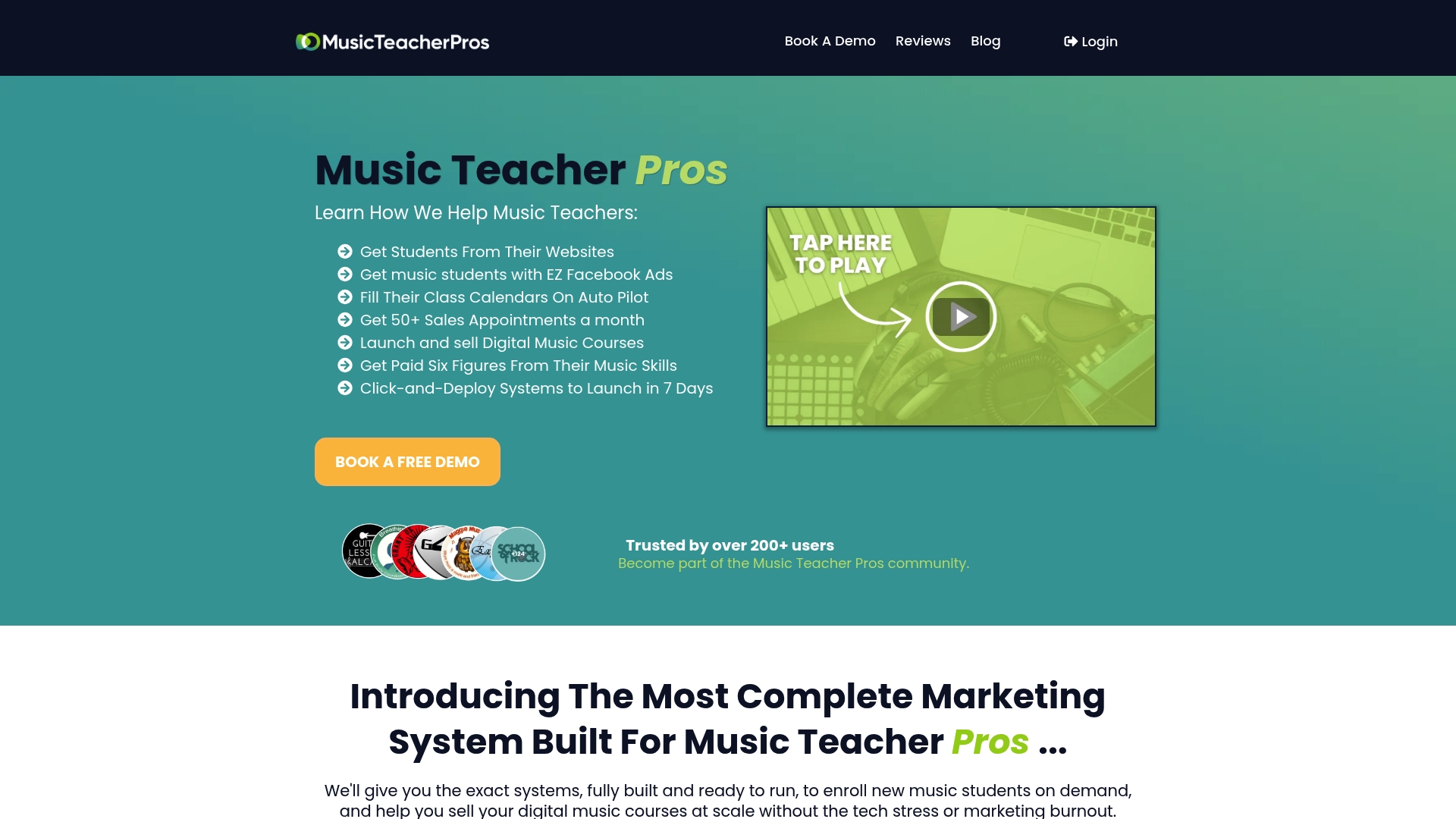
The All-In-One Marketing System includes pre-built Facebook and Google ad templates already structured around the headline, bullet, and CTA rules covered above, plus SEO-optimised landing pages and lead capture automation that follows up with enquiries automatically. It’s built for teachers and school owners who want the tracked, tested version of everything in this guide without writing it themselves. The platform includes ongoing coaching and a community of fellow educators rather than leaving you to figure out ad performance alone.
If you’d rather your next enquiry come from a properly tested ad than a lucky guess, take a look at the All-In-One Marketing System and see what’s included before you build your next campaign.
Sources
FAQ
What is the most important part of ad copy for music lessons?
The headline matters most, since it decides whether anyone reads the rest of the ad. Use the Feature→Benefit→Meaning structure in 7 to 11 words, leading with the outcome parents actually want.
Should ad copy for music lessons mention price?
Not in the headline. Research into parental decision-making for music schools found atmosphere, enjoyment, and the teacher relationship consistently outrank price, so lead with those and save cost detail for the landing page.
How many headlines should I write for a Google responsive search ad?
Google recommends supplying as many unique headlines as possible, with 8 to 10 as a practical minimum alongside at least two descriptions, then letting Smart Bidding find the best-performing combinations.
Does Musicteacherpros write ad copy for me?
Musicteacherpros’s All-In-One Marketing System includes pre-built ad templates and landing pages designed specifically for music educators, so you’re adapting proven structures rather than writing from a blank page. Current pricing is available directly on the Musicteacherpros site.
How often should I refresh my music lesson ad copy?
Refresh whenever click-through rate on a previously strong ad starts dropping, since that usually signals the audience has seen it too often rather than the offer failing. Rotating a small library of tested headlines and bullets keeps creative fresh without starting from scratch each time.