
2–6× Cheaper in 2026: ManyChat vs Chatfuel for Music Teachers
2–6× Cheaper in 2026: ManyChat vs Chatfuel for Music Teachers
ManyChat is the better default for most businesses in 2026: it’s cheaper at almost every contact tier, covers more channels, and has a bigger template community to learn from. Chatfuel earns its keep only when you’re Messenger-first and want AI baked into every flow without building a separate step for it.
TL;DR:
- ManyChat offers broader multi-channel support, including SMS and TikTok, and is typically more budget-friendly at scale than Chatfuel.
- Chatfuel provides deeper Messenger features and native AI integration, making it better for businesses prioritizing open-ended, natural conversations.
- Contact-based billing models mean small differences in audience size or activity can significantly impact monthly costs for both platforms.
- Both platforms have limited free tiers primarily for testing, and their AI features remain flow-based rather than true conversational agents.
- For most small businesses, selecting the platform depends more on their primary channel and needs for AI or multi-channel reach than on feature count.
Table of Contents
- ManyChat vs Chatfuel at a glance
- Which platform wins on features: channels, AI, templates and inbox
- What ManyChat and Chatfuel actually cost you each month
- Who should choose ManyChat and who should choose Chatfuel
- When neither ManyChat nor Chatfuel is the right tool
- How chat automation fits a music teacher marketing system
- How we evaluated ManyChat and Chatfuel
- Free plans and trials: what you actually get before paying
- Comparing customer support and service quality
- Limitations worth knowing before you commit
- What real users and case studies say
- Data privacy and compliance considerations
- A straight answer if you’re still deciding
- A managed alternative if you’d rather not build the flows yourself
- Sources
- FAQ
ManyChat vs Chatfuel at a glance
Here’s the shape of the decision before you get into the weeds. Both platforms build chatbots for Instagram, Messenger and WhatsApp, but they charge differently, think about AI differently, and serve different-sized teams.
| Feature | ManyChat | Chatfuel |
|---|---|---|
| Pricing model | Active contacts (free tier now capped at 25) | Conversations or flat AI Business Assistant plans |
| Free plan / trial | Yes, limited to 25 active contacts | Yes, trial with narrower feature access |
| Channels | Instagram, Messenger, WhatsApp, SMS, Telegram, TikTok | Instagram, Messenger, WhatsApp, website chat widget |
| AI approach | Add-on AI Steps (~$29/month extra) | Native AI built into flows |
| Best for | Instagram-first creators, multi-channel marketers | Messenger-first teams wanting AI without extra setup |
A few things jump out once you line them up side by side:
- Instagram-first? ManyChat wins on comment-to-DM triggers, story reply automation and sheer template volume.
- Messenger-first with AI as the whole point? Chatfuel’s native AI means you’re not stitching together separate logic for “human-sounding replies.”
- Need SMS or TikTok in the mix? Only ManyChat currently supports those extra channels alongside Instagram and Messenger.
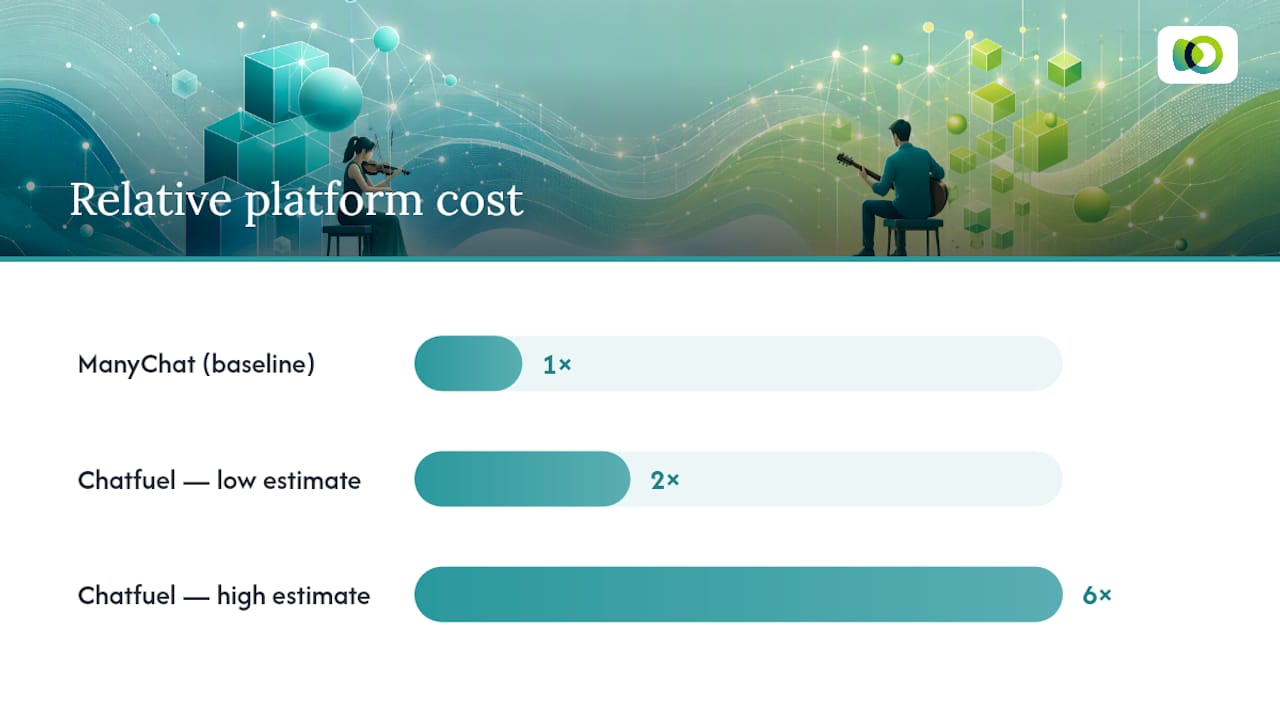
- Budget-sensitive at scale? ManyChat is often 2 to 6 times cheaper than Chatfuel once you’re past a few thousand contacts.
Pro Tip: Before comparing sticker prices, check whether a vendor bills by “active contacts” (people who’ve messaged you recently) or by “conversations” (any 24-hour message thread). The two models produce wildly different bills for the exact same audience size.
That contact-versus-conversation split matters more than most marketers realise. A brand with 10,000 followers but only 800 people who message monthly pays for 800 active contacts on ManyChat, but potentially far more conversation threads on a platform that counts every reopened chat separately. Know which meter you’re being billed against before you commit.
Which platform wins on features: channels, AI, templates and inbox
The pricing table tells you what things cost. This is where you find out why the cost differs, because the two platforms were built with different priorities from day one.
Channel coverage: broad reach versus Messenger depth
ManyChat spreads itself across Instagram, Messenger, WhatsApp, SMS, Telegram and TikTok. That breadth suits marketers running campaigns across several platforms at once, particularly anyone whose audience splits between Instagram DMs and text message reminders.
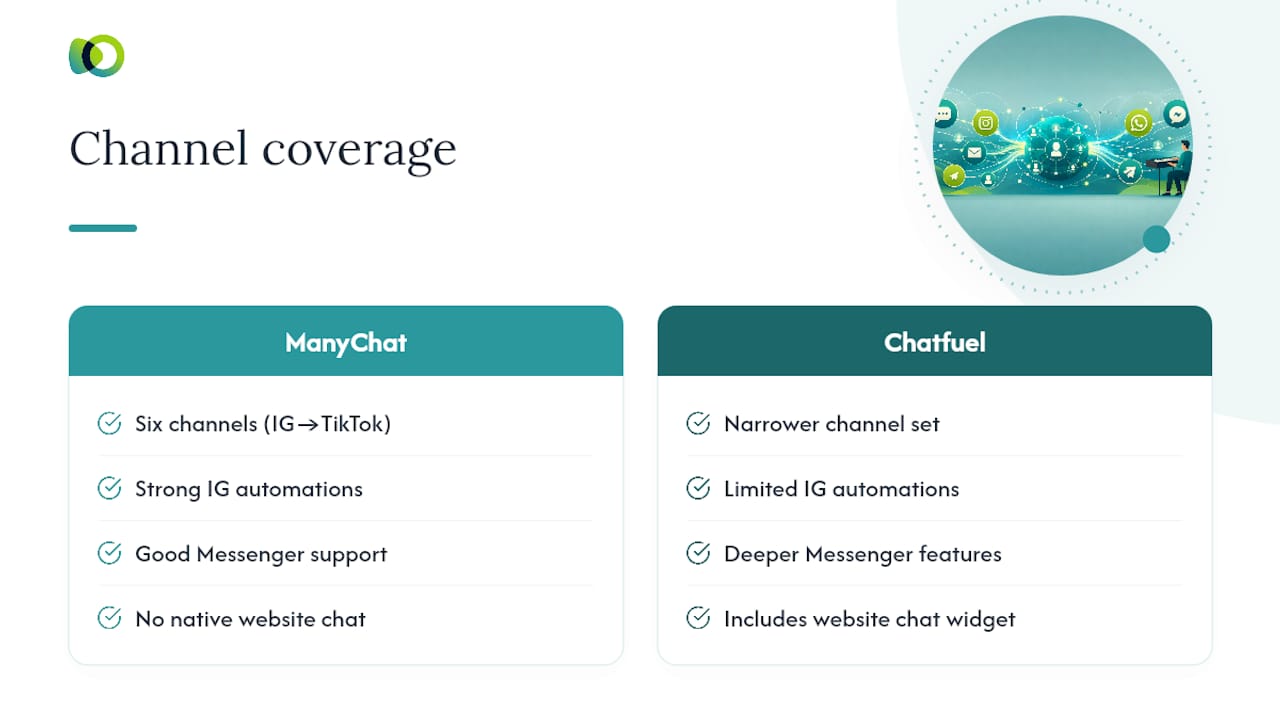
Chatfuel goes narrower but deeper. It was built from Messenger roots, and it shows: Messenger-specific features run deeper than ManyChat’s equivalent tools, and Chatfuel adds a website chat widget that ManyChat doesn’t offer natively. If your business runs primarily through a Facebook Page and a website contact form, that combination covers you without bolting on a third tool.
Instagram is where the split gets most visible. ManyChat’s comment-to-DM automation and story-reply triggers are more developed, and it leads on Instagram-specific automations and template variety. If a coach or creator’s growth strategy leans on turning post comments into private conversations, that gap is the whole ballgame.
AI: native flow logic versus an add-on step
This is the single biggest philosophical difference between the two products. Chatfuel treats AI as a first-class citizen baked into flows themselves, so a bot can hold a more natural, open-ended exchange without you scripting every branch. ManyChat instead offers an AI Step you drop into an existing rule-based flow, typically for around $29 a month on top of your base plan.
Neither approach makes the bot a true conversational AI in the way a dedicated AI assistant behaves. Both remain flow-based tools with AI sprinkled in at decision points, not free-flowing AI agents. If your business genuinely needs open-ended, human-like back and forth (a nurse triaging booking requests, for instance, or a concierge answering off-script questions), a purpose-built AI setter or a tool like AmmarAI’s conversational chat product may serve better than either chatbot platform.
For most small businesses, though, the AI add-on question boils down to cost versus need. If 90% of your enquiries fit a handful of predictable paths (“book a session,” “check pricing,” “cancel a lesson”), a rule-based flow with one AI step for the unpredictable 10% is plenty. Paying Chatfuel’s AI-inclusive pricing for that scenario is paying for capability you’ll rarely use.
Templates and the learning curve
Template count is a rough proxy for how much hand-holding you get out of the box. Chatfuel reports around 60 templates against ManyChat’s roughly 30, but raw numbers only tell half the story. ManyChat’s smaller library leans on step-by-step walkthroughs that suit someone building their first flow, while Chatfuel’s larger set assumes slightly more comfort experimenting.
Neither platform demands coding knowledge. Both use drag-and-drop flow builders where you connect message blocks visually, and both have active communities (Facebook groups, YouTube tutorials, vendor documentation) where you can copy a working structure rather than starting from a blank canvas.
Inbox, team features and integrations
Once messages start coming in, the inbox is where your team actually lives day to day. Both platforms offer a shared inbox with tagging, conversation assignment and basic notes, letting more than one person handle replies without stepping on each other.
Where they diverge is depth of CRM-lite functionality: contact tagging for segmentation, automated follow-up sequences triggered by tags, and broadcast messaging to specific segments. Integration-wise, both connect to Shopify, Zapier or Make for wider automation, and both support common CRM handoffs, though the exact connector list varies by plan tier, so it’s worth checking the current integration directory before assuming a specific tool is covered.
What ManyChat and Chatfuel actually cost you each month
Pricing is where “it depends” becomes a genuine, calculable answer rather than a dodge. Both vendors bill primarily on your audience size or activity level, then add channel-specific fees on top for WhatsApp.
ManyChat’s free tier now caps out at just 25 active contacts, a sharp cut from what many marketers remember from earlier years. Its entry paid tier starts at around a dozen dollars a month and scales upward with your contact count. Chatfuel, meanwhile, has moved toward simplified plan structures during 2026, with some markets seeing consolidated tiers, including an AI Business Assistant flat plan reported around $69 a month in certain configurations. Because both vendors have reorganised pricing during 2026, always check the live vendor pricing page before signing up rather than trusting a screenshot from last year’s comparison post.
Here’s how that plays out across three realistic scenarios:
These figures are illustrative planning ranges based on 2026 vendor reporting, not a quote. Confirm exact numbers against each vendor’s current pricing page before budgeting.
On top of subscription costs, WhatsApp conversation fees set by Meta pass straight through on both platforms, regardless of which chatbot tool you’re using. Neither ManyChat nor Chatfuel absorbs that cost. Add-ons compound the picture too: ManyChat’s AI Step add-on runs for an extra monthly fee in the range of a few tens of dollars, and inbox seats for additional team members often carry their own per-seat charge on both platforms.
A few habits keep this bill predictable rather than surprising:
- Archive or remove contacts who haven’t engaged in 90+ days before your next billing cycle.
- Tag campaign-specific contacts so you can spot and prune one-off spikes after a viral post.
- Watch for the exact moment a promotion pushes you into a higher contact tier, and decide in advance whether that trade-off is worth it.
A sudden influx of one-off messages from a viral post can unexpectedly raise your bill on either platform, since both charge by active users or conversations rather than a flat seat price. Treat contact list hygiene the same way you’d treat an email list: prune it, or pay for the dead weight.
Who should choose ManyChat and who should choose Chatfuel
Trade-offs only matter once you map them onto your actual business. Run through these checklists honestly before you commit to a trial.
- Choose ManyChat if: you’re Instagram-first, running comment-to-DM campaigns, need SMS or Telegram alongside Meta apps, or you’re price-sensitive below a few thousand contacts.
- Choose Chatfuel if: your business runs primarily through Messenger, you want AI-driven open-ended replies without configuring a separate step, or you need a native website chat widget alongside your social channels.
- Consider Respond.io if: your team already juggles five or six channels and needs one shared inbox to centralise everything rather than logging into separate chatbot dashboards.
- Consider FlowGent or Currai if: you want a narrower, workflow-specific automation tool, or you’re experimenting with AI-centred chat features outside the two market leaders.
Three quick prompts to settle the decision during a trial:
- Where does most of your enquiry volume actually arrive, Instagram DMs, Messenger, or your website?
- Does your team need AI to handle genuinely unpredictable questions, or would a handful of scripted flows cover 90% of what comes in?
- What’s your realistic contact count in six months, and which billing model punishes growth less?
Respond.io tends to win when centralisation matters more than any single channel’s depth. FlowGent and Currai show up in comparative roundups as narrower tools worth a look if your workflow has a specific quirk neither market leader handles well, though neither has the ecosystem depth of the two main platforms.
When neither ManyChat nor Chatfuel is the right tool
Sometimes the honest answer is that a flow-based chatbot, whichever brand, isn’t what you need. Both ManyChat and Chatfuel remain fundamentally rule-based systems with AI layered on top, not genuinely free-form conversational agents.
Skip both and look elsewhere when:
- You need a bot that holds a natural, unscripted conversation rather than following branching logic, in which case a dedicated AI setter or conversational agent fits better.
- Your enquiries arrive across six or more channels and you need one inbox to rule them all, which points toward an omnichannel centralisation tool like Respond.io.
- You need enterprise SLAs, guaranteed uptime commitments or fixed, predictable pricing regardless of contact spikes, something flat-fee enterprise messaging platforms handle better than contact-based consumer chatbot tools.
- Your core need is a website-first support widget rather than social DM automation, where a purpose-built live chat product may outperform either platform’s bolted-on widget.
How chat automation fits a music teacher marketing system
For a private music teacher or school owner, a chatbot isn’t the whole marketing engine. It’s one gear in it. The highest-value use cases are narrow and specific: a comment-to-DM funnel that catches leads from a short video of a student nailing a difficult passage, an automated reminder sequence that stops no-shows before they happen, and a tagging system that follows up on trial lessons until they convert into recurring bookings.
The features that actually matter to an educator are rarely the flashiest ones. Calendar links inside the flow, tags that separate “trial booked” from “enrolled,” and automated reminders save more admin time than any AI-generated small talk ever will.
- Use comment-to-DM automation on Instagram Reels to catch parents asking “do you teach beginners?”
- Tag every trial-lesson lead and trigger a three-touch follow-up sequence over the following two weeks.
- Pair calendar links inside the chat flow with automated lesson reminders to cut no-shows.
Pro Tip: Don’t build your first flow around answering every possible question. Build it around your one highest-volume enquiry, “how do I book a lesson?”, and get that path flawless before adding anything else.
Some services work with music educators building these automation paths as part of a wider student-attraction system, and the pattern holds consistently: teachers who automate the boring follow-up steps convert more trials into paying students, not because the bot is clever, but because nobody forgets to send the reminder.
How we evaluated ManyChat and Chatfuel
This comparison rests on published 2026 vendor pricing pages, feature documentation, and independent comparative reporting rather than a single vendor’s own marketing copy. Where pricing or plan structures were reported to have changed during 2026, that’s flagged explicitly rather than treated as settled fact, because both vendors have adjusted tiers this year.
The criteria weighted most heavily were the ones that actually change a business’s monthly bill and daily workflow: billing model (contacts versus conversations), channel breadth, how AI is packaged (native versus add-on), template depth, and inbox team features. Pricing examples were built as illustrative planning scenarios based on reported per-tier costs, not as live quotes, precisely because chatbot pricing shifts often enough that a snapshot goes stale within months.
Claims about specific numbers, template counts, free-tier limits and AI add-on pricing are each tied to a named, dated source rather than presented as settled industry knowledge. Where sources disagreed on exact figures (as with Chatfuel’s shifting 2026 tier names), the more recent, more specific reporting was preferred, and the discrepancy is noted rather than smoothed over.
Free plans and trials: what you actually get before paying
ManyChat’s free tier now caps at just 25 active contacts, a steep drop from the more generous limits marketers may remember from a couple of years back. That’s enough to test flow logic and see how the interface feels, but not enough to run a real campaign.
Chatfuel’s trial similarly gives you narrower feature access than a paid plan, enough to build and test a flow before committing. Neither vendor’s free tier is designed for you to run your actual business on indefinitely. Treat both as evaluation windows, not permanent free plans.
The practical move is to use the trial period to answer one question only: does this platform’s flow builder match how you think? Build your single most important flow (usually the booking or enquiry path) inside the free tier before evaluating anything else. If the logic feels intuitive within an hour, that’s a stronger signal than any feature checklist.
Comparing customer support and service quality
Support quality is one of the harder things to compare cleanly, because both vendors lean heavily on self-serve documentation, community forums and templated help articles rather than instant live support for lower-tier plans. Higher-paid tiers on both platforms typically unlock faster or more direct support channels.
ManyChat’s larger community works in its favour here. A bigger user base means more third-party tutorials, more answered questions in Facebook groups, and more templates built by other users you can borrow rather than build from scratch. Chatfuel’s smaller but more AI-focused community tends to produce more technical discussion around its native AI features specifically.
Neither platform currently markets dedicated account management at entry-level pricing, so expect to lean on documentation and community answers unless you’re on a higher tier.
Limitations worth knowing before you commit
Every chatbot platform has ceilings, and hitting one mid-campaign is worse than knowing about it in advance. ManyChat’s free tier limit of 25 active contacts is restrictive enough that most real businesses outgrow it within their first week of active marketing.
Chatfuel’s conversation-based billing on some plans means a spike in one-off messagers, people who message once and never return, can inflate your bill without adding genuine long-term value. Both platforms’ AI features remain flow-based rather than fully open-ended, so neither substitutes for a dedicated AI agent if your use case genuinely demands unscripted conversation. Channel coverage gaps matter too: Chatfuel doesn’t natively support SMS, Telegram or TikTok the way ManyChat does, so a multi-channel strategy beyond Meta’s apps and website chat will hit a wall on Chatfuel specifically.
What real users and case studies say
Independent comparative reviews consistently land in the same place: ManyChat is recommended as the default for most creators and small businesses due to lower costs, stronger Instagram tooling, and a larger support community, while Chatfuel is recommended specifically when Messenger and built-in AI are the primary requirement.
That pattern holds across the comparative reporting reviewed for this piece rather than being a one-off opinion. The consistent theme across independent reviews is that the “best” platform depends far more on which channel carries your enquiry volume than on any single feature checklist item, which is exactly why the persona-based checklist earlier in this piece matters more than a raw feature count.
Data privacy and compliance considerations
Both platforms operate within Meta’s own platform policies for Instagram, Messenger and WhatsApp, meaning your bot’s behaviour on those channels is bound by Meta’s messaging and data-use rules regardless of which chatbot vendor you choose. That includes opt-in requirements for marketing messages and the 24-hour messaging window rules that govern when a business can message a contact without a template-approved format.
Beyond Meta’s own rules, compliance obligations (data storage location, consent record-keeping, regional privacy law such as GDPR) sit with the vendor’s own infrastructure and terms of service. Check each vendor’s current data processing agreement and privacy documentation directly rather than assuming parity between the two, since specific data handling practices can differ and change over time.
A straight answer if you’re still deciding
Here’s the honest read: if you’re weighing this decision for more than an afternoon, you’re probably overthinking it. Pick based on where your enquiries already arrive, not where you wish they arrived. Run three quick tests during your trial: connect an Instagram comment-to-DM flow, send one AI-handled reply, and simulate a full booking through to calendar confirmation. If all three feel smooth within a week, you’ve picked correctly. Success in the first 30 days looks like measurable response time drops and trial-to-booking conversion ticking upward, not a perfectly polished flow.
— Liam
A managed alternative if you’d rather not build the flows yourself
Both ManyChat and Chatfuel hand you the building blocks, but you still have to design the flows, write the sequences, and keep tweaking them as Meta changes its rules. If that sounds like one more thing competing for your teaching time, Musicteacherpros takes a different route entirely: a managed marketing system built specifically for music educators, rather than a chatbot tool you configure yourself.
Instead of piecing together comment-to-DM triggers and reminder sequences on your own, Musicteacherpros pairs pre-built Facebook and Google ad campaigns with automation for lead capture and follow-up, an SEO-optimised website, and calendar integrations designed around how music teachers actually book students. You also get ongoing coaching and access to a community of fellow educators, so you’re not troubleshooting flow logic alone at 11pm before a lesson. If you’d rather have the automation, the ads, and the follow-up system handled for you, start with the Music Teacher Pros system and see how it maps onto your studio.
Sources
- Manychat vs. Chatfuel: Which should you use? - Zapier
- ManyChat vs Chatfuel: Which Is Better? (2026) - SetSmart
- ManyChat vs Chatfuel 2026: Which Is Better? (+Best Alternative) - brandID
- Chatfuel vs ManyChat · 2026 chatbot comparison · Botapolis
FAQ
Is there anything better than ManyChat?
It depends on your priority: Chatfuel suits Messenger-first businesses wanting native AI, Respond.io suits teams needing one omnichannel inbox, and a dedicated AI setter suits anyone needing genuinely open-ended conversation rather than flow-based automation.
How much does Chatfuel cost?
Chatfuel’s pricing has shifted during 2026 toward simplified plans, with some markets reporting an AI Business Assistant flat plan around $69 a month, though exact tiers vary, so check the current vendor pricing page before budgeting.
Which platform is cheaper, ManyChat or Chatfuel?
ManyChat is generally cheaper across most contact sizes, often two to six times less expensive than Chatfuel once you scale past a few thousand contacts.
Does ManyChat or Chatfuel support WhatsApp better?
Both support WhatsApp, but Meta’s own per-conversation fees apply on top of either vendor’s subscription, so the platform choice doesn’t change that cost.
Can a music teacher use these chatbot platforms alone, without other marketing tools?
A chatbot alone captures and follows up on leads, but it doesn’t generate them. Music teachers typically pair chat automation with ad campaigns and a lead-capture website, which is the combined approach a managed system like Musicteacherpros builds around.