
Facebook vs Google Ads: a practical guide for small businesses
Facebook vs Google Ads: a practical guide for small businesses
If you sell something people are already searching for, start with Google Ads. If you need to create demand, build an audience, or sell something visual, start with Facebook/Meta Ads. That is the short answer, and most small UK businesses fall clearly into one camp or the other.
- Favour Google Ads when your customers already know they need what you offer and are typing it into search (plumbers, accountants, music lessons, solicitors).
- Favour Facebook/Meta Ads when your customers do not yet know they want your product, or when visual storytelling and community are central to how you sell (online courses, DTC products, lifestyle brands, coaches).
Long-term, the strongest approach is to run both as a funnel: Meta builds awareness at the top, Google captures the resulting search intent at the bottom. When budget is tight, pick the platform that matches how your customers actually buy, prove it works, then layer on the second.
Table of Contents
- How do Facebook Ads and Google Ads compare side by side?
- What do Google Ads and Facebook Ads actually do?
- When does Google Ads give you the clearest advantage?
- When does Facebook/Meta Ads give you the clearest advantage?
- What does it actually cost? Budgets, CPCs, and the £10/£20 question
- Key operational differences that change your results
- Which platform should you choose based on your goal?
- How to choose: a decision checklist you can run through today
- How do you measure success properly across both platforms?
- How do you run Meta and Google together as a funnel?
- Practical campaign templates for music teachers
- Key takeaways
- The decision I would actually make for a small UK business
- How Musicteacherpros helps music teachers run both channels without the complexity
- Useful sources and further reading
- FAQ
How do Facebook Ads and Google Ads compare side by side?
| Dimension | Google Ads | Facebook / Meta Ads |
|---|---|---|
| Best for | Demand capture, local services, B2B, high-intent purchases | Demand generation, DTC, visual products, courses, community |
| User intent | Active search (pull) | Passive discovery (push) |
| Targeting | Keywords, search queries, location, device | Demographics, interests, behaviours, lookalikes, retargeting |
| Ad formats | Search text, Shopping, Display, YouTube, Local, Lead Forms | Image, video, carousel, Stories, Reels, Messenger, Audience Network |
| Typical CPC | Higher (Google Search competitive verticals often sit above £2–£5+) | Raw CPCs typically lower than Google Search, but conversion rates are also lower; the true comparison is cost per lead or cost per acquisition, which varies by industry. |
| Typical CPM | Varies widely by network and vertical | Tends to be lower than Google Search CPM |
| Recommended objectives | Conversions, leads, sales, branded search defence | Awareness, traffic, lead generation, catalogue sales, app installs |
| Time to signal | Directional data often within a few days | Learning phase typically 7–14 days before stable performance |
| Measurement | Google Tag, conversion tracking, offline uploads | Meta Pixel, Conversions API, lead forms |
A few things worth flagging beyond the table:
- Raw CPC is not the number that matters. Cost per acquisition or return on ad spend is the relevant comparison, because a £0.30 click that never converts is more expensive than a £3.00 click that books a lesson.
- For UK small businesses, a realistic starting test budget is moderate per platform per month. Below that, advertisers may work with thin data.
- Google’s auction is keyword-driven; Meta’s is audience-driven. The creative implications are completely different, which we cover below.
What do Google Ads and Facebook Ads actually do?
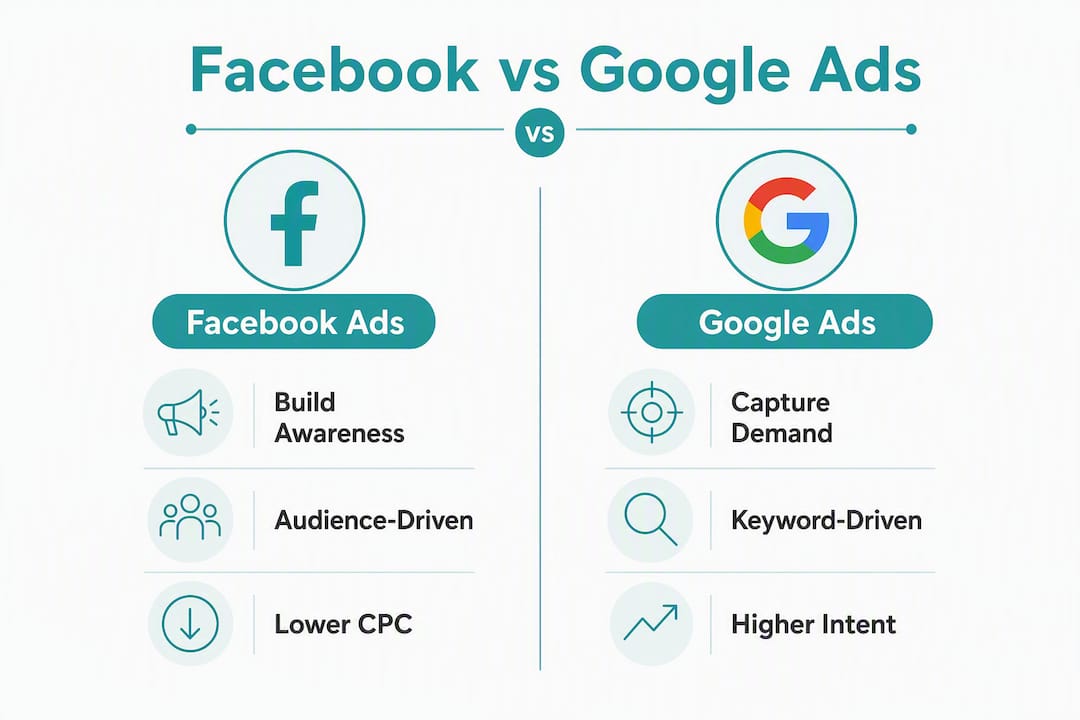
Google Ads is a demand-capture tool: it intercepts people who are already looking for something. A user types “guitar lessons in Manchester” and your ad appears. The intent is baked into the query. You are not persuading anyone to want guitar lessons; you are simply making sure they find you instead of someone else.
Facebook/Meta Ads work the opposite way. They are a demand-generation tool: they surface your message to people who match a profile you define, whether or not those people are currently thinking about buying. Think of it as a well-placed billboard on a road your ideal customer drives every day, rather than a sign outside a shop they are already walking into.
The practical consequence: Google Ads rewards relevance to a query. Facebook/Meta Ads reward creative quality and audience modelling. The skills, the creative briefs, and the optimisation levers are genuinely different on each platform.
Where each platform sits in a typical buying journey:
- Discovery / awareness: Meta (Facebook, Instagram, Reels, Stories)
- Consideration / interest: Meta retargeting, YouTube, Google Display
- Intent / decision: Google Search, Google Shopping, Google Local
Most small businesses only run ads at one stage and wonder why results are inconsistent. The funnel framing is not just theory; it is the reason the two platforms complement rather than compete with each other.

When does Google Ads give you the clearest advantage?
Google Ads wins when purchase intent is already present. If someone is typing a specific query, they are raising their hand. Your job is to be the most relevant answer.
The situations where Google typically leads:
- Local services with urgent need: plumbers, dentists, music teachers, tutors, solicitors. People search when they need help now, and Google’s search, local, and lead form ad types are built precisely for this capture moment.
- High-consideration B2B purchases: software, professional services, equipment. Buyers research before they buy, and search ads intercept that research phase.
- Branded search defence: if competitors are bidding on your brand name, you need to be there. Letting a competitor own your brand’s search results is an expensive mistake.
- Shopping and ecommerce with clear product demand: if people search for “acoustic guitar under £200,” Google Shopping puts your product image, price, and rating directly in front of them.
Practical UK use cases:
- A piano teacher in Leeds running search ads on “piano lessons Leeds” and “learn piano adults Leeds” captures parents and adult learners at the exact moment they are ready to book.
- A music school running Local campaigns gets its Google Business Profile surfaced in Maps results alongside a click-to-call button.
- A B2B music equipment supplier uses Performance Max campaigns to cover search, Shopping, and Display from a single campaign structure.
For a deeper look at how Google Display vs Search campaigns differ in practice, that distinction matters when you are deciding where to allocate budget within the Google ecosystem. You can also find practical Google Ads budget guidance for small businesses to help set realistic expectations before you start.

When does Facebook/Meta Ads give you the clearest advantage?
Meta’s strength is reach and creative storytelling at scale. A single Meta campaign can surface across Facebook, Instagram (feed, Stories, Reels), Messenger, Threads, and the Audience Network automatically, giving you enormous placement variety from one setup.
Where Meta leads:
- Visual and lifestyle products: clothing, food, fitness, music gear, instruments. If your product looks good, Meta’s visual formats do the selling.
- Online courses and coaching: people do not typically search “online piano course for beginners” the way they search for a local plumber. You need to put the idea in front of them. Meta is built for this.
- Community-building brands: if your business grows through belonging (a music teacher community, a fitness tribe, a creative collective), Meta’s social fabric supports that better than any search engine.
- App installs and DTC brands: Meta’s catalogue ads and dynamic retargeting are particularly strong for ecommerce brands with product feeds.
What actually drives performance on Meta:
- Creative quality. Meta’s algorithm treats creative as the primary performance lever, not narrow audience targeting. A great video or image with broad targeting will often outperform a mediocre creative with a tightly defined audience.
- Audience modelling. Lookalike audiences built from your existing student or customer list can find people who behave like your best customers, even if they have never heard of you.
- Retargeting. People who visited your website but did not book are warm leads. Meta retargeting keeps you in front of them at a fraction of the cost of acquiring a cold lead.
For music teachers specifically, Meta is where you build the “I want to learn an instrument” feeling in someone who has not yet committed to lessons. That is demand generation in its purest form.
What does it actually cost? Budgets, CPCs, and the £10/£20 question
Cost is where most small business owners get confused, because the headline numbers are misleading. Meta’s raw CPC and CPM tend to sit lower than Google Search, but that does not make Meta cheaper per customer acquired. A lower-cost click from someone who was not looking to buy converts at a lower rate.
Rough benchmarks (UK market, 2025–2026 data):
- Google Search CPC: competitive verticals such as legal, finance, and insurance can have high costs per click; local services and education typically have lower costs per click.
- Meta CPC: typically lower than Google Search in raw terms, but conversion rates are also lower due to the weaker intent; cost per lead is the real metric and varies significantly by industry, offer quality, and landing page.
- Cost per lead: local music lesson leads via Google may have moderate to higher costs per lead; online course leads via Meta may have lower CPL when the creative is strong.
Statistic to keep in mind: benchmarks across industry analyses consistently show Google Search delivering higher conversion rates per click than Meta, while Meta delivers more impressions and reach per pound spent. Neither is universally cheaper per customer.
Is £10 a day enough?
On Meta, a moderate daily budget can generate meaningful data if your audience is broad enough and your creative is strong. It is workable for a local music teacher testing a lead generation campaign, but you will need patience through the 7–14 day learning phase before the algorithm stabilises.
On Google Search, £10/day in a competitive local market may produce only a handful of clicks per day. That is not enough volume to optimise quickly. For Google, £20/day is a more realistic floor for a local service business, and even then, you are working with thin data in the early weeks.
Three practical budget scenarios:
- Local lesson sign-ups (Google Search): £15–£25/day, keyword-focused, conversion-tracked to enquiry form or phone call.
- Online course launch (Meta): £10–£20/day for a 2–3 week awareness and lead-gen push, with a separate retargeting budget of £5/day.
- Awareness campaign (Meta): £5–£10/day can build a meaningful local audience over 30 days if your creative is compelling.
Key operational differences that change your results
Understanding the mechanics of each platform stops you from making expensive mistakes.
Auction dynamics and bidding
Google’s auction is keyword-driven. You bid on specific search terms, and the platform weighs your bid against your Quality Score (relevance, expected click-through rate, landing page experience). A high Quality Score can win auctions at lower bids than a competitor with a poor-quality ad.
Meta’s auction is audience-driven. You define who you want to reach, set a budget, and Meta’s algorithm decides when and where to show your ad to maximise your chosen objective. There is no keyword list; the creative and the audience signal do the work.
Learning curves and optimisation cadence
| Platform | Initial signal | Stable performance | Optimisation rhythm |
|---|---|---|---|
| Google Search | a few days | 2–4 weeks | Weekly bid and keyword review |
| Meta | 7–14 day learning phase | 3–4 weeks | Avoid changes during learning; review weekly after |
Privacy changes and targeting restrictions
Apple’s iOS privacy updates reduced Meta’s ability to track off-platform behaviour, which hit retargeting accuracy and attribution. Meta responded with the Conversions API (server-side tracking) to partially restore signal. Google faces similar pressure from third-party cookie deprecation and has pushed its own first-party data solutions.
Both platforms have tightened ad approval policies around sensitive categories (health, finance, housing). Music education is a low-risk category, but any ad that implies guaranteed results or uses before/after framing can trigger a review.
Pro Tip: On Meta, avoid making large structural changes (new ad sets, audience swaps, budget increases above 20%) during the learning phase. Small tweaks reset the clock and cost you data.
Which platform should you choose based on your goal?
The honest answer is that there is no universal winner. The right platform follows the customer’s buying behaviour, not your preference.
By campaign goal:
By business type:
- Music teachers: — See the dedicated templates section below. The short answer: Google for “music lessons near me” searches; Meta for building an audience around your teaching style and course content.
For music teachers running Facebook ad campaigns, understanding CBO vs ABO campaign structures on Meta can meaningfully affect how your budget is distributed across ad sets.
How to choose: a decision checklist you can run through today
Work through these questions before you spend a penny.
Step 1: Who is your customer and how do they buy?
- Do they search for your service by name or category? → Google Search
- Do they discover products/services through social feeds? → Meta
- Both? → Start with the stronger signal, then add the second.
Step 2: What is your margin per customer?
- If a customer is worth £50 to you, a £15 cost per lead is viable. If they are worth £500, you have much more room to test.
- Rule of thumb: your target cost per lead should be no more than 10–20% of customer lifetime value.
Step 3: What creative assets do you have?
- Strong video or photography? Meta will reward you.
- No visual assets but a clear offer? Google Search does not need images.
Step 4: What does your landing page do?
- A landing page that does not load quickly, does not have a clear call to action, or asks for too much information will kill results on either platform.
Step 5: What is your minimum test budget?
- Google Search: plan for at least £300–£500 to gather enough click data to make decisions.
- Meta: £200–£300 can generate a learning phase, but £500 gives you more creative testing room.
Red flags that mean you should pause:
- Your landing page has no conversion tracking installed.
- You are judging performance after fewer than 50 clicks (Google) or before the Meta learning phase ends.
- You are optimising for clicks rather than leads or sales.
- Your ad account has been restricted or flagged for policy violations and you have not resolved them.
- You are running ads to a page that loads in more than 3 seconds on mobile.
How do you measure success properly across both platforms?
Measurement is where most small businesses leave money on the table. Running ads without proper conversion tracking is like driving with no speedometer: you might be going the right speed, but you genuinely cannot tell.
Setting up conversion tracking:
- Install Google Tag Manager on your website. Use it to fire both the Google Ads conversion tag and the Meta Pixel from one place.
- Set up the Meta Conversions API alongside the Pixel. Privacy changes mean server-side tracking is now the recommended approach for both platforms, as it reduces data loss from browser restrictions and ad blockers.
- Define your conversion events clearly: a form submission, a phone call, a purchase, a booking. Track the same events on both platforms so you can compare like for like.
- Upload offline conversions where relevant (e.g. a student who enquired online but booked by phone).
Attribution models:
- Last-click attribution gives all credit to the final touchpoint before conversion. It tends to over-credit Google Search and under-credit Meta, because Meta often influences the journey earlier.
- Data-driven attribution (available in Google Ads and Meta) distributes credit across touchpoints. More accurate, but requires sufficient conversion volume to work well.
- For small budgets, a simple incrementality check works: pause one platform for two weeks and measure whether total leads or sales drop. Crude, but honest.
Pro Tip: Keep your UTM parameters consistent across both platforms. If Google and Meta use different naming conventions in your UTM tags, your analytics data becomes impossible to compare cleanly.
For local service businesses, a missed call text-back system captures leads who call from a Google ad but do not leave a voicemail, closing a gap that most small businesses never notice.
How do you run Meta and Google together as a funnel?
The most effective paid-media approach treats the two platforms as complementary stops on the same customer journey. Meta creates awareness and builds intent; Google captures the resulting search behaviour.
A simple funnel blueprint:
- Top of funnel (Meta): Run a video or image campaign to a cold audience defined by interests, location, and demographics. Objective: video views or traffic. Budget: 50–60% of total paid media spend.
- Mid-funnel (Meta retargeting): Retarget people who watched 50%+ of your video or visited your website. Objective: lead generation or conversions. Budget: 20–25% of total spend.
- Bottom of funnel (Google Search): Capture people who search for your brand name or category keywords after seeing your Meta ads. Objective: conversions. Budget: 20–30% of total spend.
Budget split examples:
- Moderate total monthly budgets can be allocated with a majority to Meta cold campaigns, some to Meta retargeting, and the remainder to Google Search.
- Budget proportions may scale with total spend.
- Actual amounts depend on business needs and performance.
Audience handoff tips:
- Build a Meta custom audience from your Google Ads landing page visitors (using the Meta Pixel). This means people who clicked a Google ad but did not convert will see your Meta retargeting ads.
- Use your Meta lead list to create a Google Customer Match audience for Gmail and YouTube ads.
Pro Tip: When both platforms run simultaneously, branded search volume on Google often increases. This is Meta doing its job. Do not cut the Meta budget because Google Search is “performing better” — the two are connected.
Practical campaign templates for music teachers
Music teachers face a specific challenge: most potential students do not wake up thinking “I need a music teacher today.” Some do (the Google Search opportunity), but many need to be shown why learning an instrument matters to them right now (the Meta opportunity). Here are three ready-to-use templates.
Template 1: Local lesson sign-ups (Google Search)
- Objective: Conversions (lead form or phone call)
- Budget: £15–£20/day
- Keywords: “guitar lessons [city]”, “piano teacher near me”, “music lessons for kids [city]”, “learn [instrument] [city]”
- Ad copy: Headline 1: “Guitar Lessons in [City]” / Headline 2: “Book a Free Trial Lesson Today” / Headline 3: “Experienced, DBS-Checked Teacher”
- Landing page essentials: Clear headline, photo of you teaching, a short bio, a simple booking form (name, email, phone, preferred instrument), and a Google review widget.
- KPI to monitor: Cost per enquiry. Target: under £15 per qualified lead.
Template 2: Online course launch (Meta)
- Objective: Lead generation (Meta Lead Form or website conversion)
- Budget: £10–£15/day for 3 weeks pre-launch, £20/day during launch week
- Audience: Parents of children aged 5–14 within 30 miles, OR adults aged 25–45 interested in music, guitar, piano, or creative hobbies
- Creative: A 30–60 second video of you teaching, showing a student’s progress. Authentic, beats polished.
- Ad copy hook: “What if your child could play their favourite song in 8 weeks?” or “You’ve always wanted to learn piano. Here’s why now is the right time.”
- KPI to monitor: Cost per lead. Target: under £8 for an online course lead.
Template 3: Nurture funnel (Meta retargeting)
- Objective: Conversions
- Budget: £5–£8/day
- Audience: Website visitors in the last 30 days who did not submit a form; video viewers (50%+) from Template 2
- Creative: A testimonial-style image or short video. Social proof is the primary lever here.
- Ad copy: “Still thinking about it? Here’s what [first name of a real student, with permission] said after their first month.”
- KPI to monitor: Cost per booking. This should be your lowest-cost conversion source once the funnel is running.
Landing page and lead-capture checklist for music teachers:
- Mobile-first design (most ad traffic arrives on mobile)
- Load time under 2 seconds
- Single, clear call to action above the fold
- Booking form with no more than four fields
- At least three genuine Google or Facebook reviews visible on the page
- A short video of you teaching (even 30 seconds builds trust dramatically)
For music teachers who also run online lessons or webinars, choosing the right webinar platform affects how smoothly your ad-to-enrolment funnel works end to end.
Key takeaways
Google Ads captures existing demand through search intent, while Facebook/Meta Ads generate new demand through audience targeting and creative, making them complementary rather than competing channels for most small UK businesses.
| Point | Details |
|---|---|
| Platform choice follows buying behaviour | If customers search for you, start with Google; if they need to discover you, start with Meta. |
| Cost per outcome beats cost per click | Meta’s lower raw CPC does not mean cheaper customers; measure cost per lead or cost per acquisition, which varies by industry. |
| Budget floors matter | Google Search needs roughly £300–£500 to gather actionable data; Meta can start learning from £200–£300. |
| The funnel approach outperforms single-platform | Meta builds awareness at the top; Google captures the resulting search intent at the bottom. |
| Musicteacherpros provides ready-built campaigns | Music teachers can access pre-built Facebook and Google ad campaigns, landing pages, and automation without building from scratch. |
The decision I would actually make for a small UK business
There is a version of this debate that gets very academic very quickly, and I want to cut through it. Most small business owners do not have the time or budget to run sophisticated multi-platform funnels from day one. So here is how I would actually think about it.
If you are a local service business (and most music teachers are, at least initially), Google Search is where I would put the first £300. The intent signal is just too strong to ignore. Someone typing “piano lessons in Bristol” is ready to book. You do not need to convince them they want lessons; you just need to be the most credible option when they look.
Once that is working and you have a cost per lead you can live with, then I would layer Meta on top. Not to replace Google, but to build the audience of people who are not yet searching. That is where you grow beyond the pool of people who already know they want what you offer.
The thing most people underestimate is the creative requirement on Meta. It is not enough to have a decent offer. You need a video or image that stops someone mid-scroll. For music teachers, that is actually an advantage: a 30-second clip of a student playing something recognisable is more compelling than almost any written ad. Use that.
On measurement, I would keep it simple at first. Track one conversion event per platform, compare cost per lead weekly, and do not make structural changes until you have at least 30–50 conversions to learn from. Patience here is not passive; it is the active choice that stops you from burning budget on premature optimisation.
The businesses I see struggle most are the ones who switch platforms every few weeks because “it is not working.” Paid ads are not a light switch. They are a dial you turn gradually, with data guiding every adjustment.
How Musicteacherpros helps music teachers run both channels without the complexity
Running Google and Meta campaigns well takes time, creative skill, and a willingness to test and iterate. Most music teachers would rather be teaching. That is exactly the gap Musicteacherpros fills.
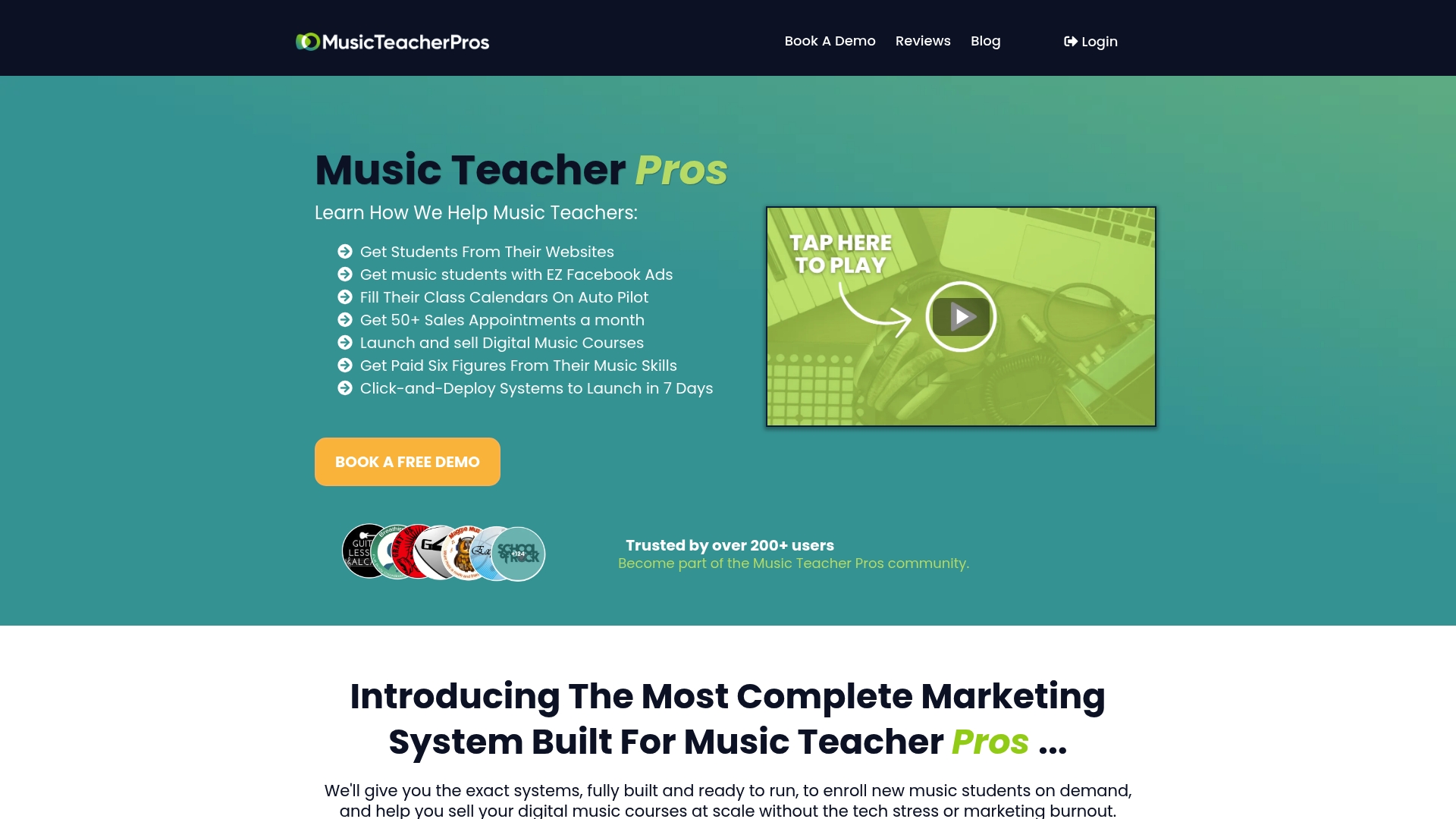
Rather than spending months figuring out campaign structures, ad copy, and landing page design, music teachers who use Musicteacherpros get pre-built Facebook and Google ad campaigns that are already set up for the music education market. The system includes lead capture automation, follow-up sequences, SEO-optimised landing pages, and ongoing coaching so you are not working it out alone. Over 50,000 students worldwide have been connected with teachers through this platform.
The practical next step is straightforward: visit Musicteacherpros to see the marketing system in action and find out whether it fits your teaching business. No long-term lock-in required to explore what is on offer.
Useful sources and further reading
For readers who want to go deeper on platform mechanics, benchmarks, or policy details, these are the sources referenced throughout this article:
- Facebook Ads vs. Google Ads: Which Should You Use? — Victoria Alenich: clear breakdown of the demand-capture vs demand-generation distinction.
- Google Ads vs. Meta Ads in 2026: Which Platform Wins — Groas: covers budget allocation, combined funnel strategy, and Conversions API guidance.
- Facebook Ads vs Google Ads: Which Is Better? — Hawky.ai: practical cost comparisons and small-budget guidance.
- Facebook Ads vs Google Ads: Which Is Better in 2026? — Superscale: benchmarks for CPC, CPM, and conversion rates across platforms.
- Google Ads vs Facebook Ads: Which Is Better? — Shopify: strong framing on cost-per-outcome and industry-based decision-making.
- Facebook Ads vs. Google Ads — WordStream: authoritative overview of how the two platforms complement rather than compete.
- Google Ads Budget for Small Businesses — Denver County Web Design: practical budget guidance transferable to UK small businesses.
A note on UK relevance: benchmark figures cited in this article come primarily from US and global industry analyses. UK CPCs and CPLs can differ, particularly in local service categories. Use the figures as directional guidance and validate against your own account data after the first 30 days of running.
FAQ
Is it better to run ads on Facebook or Google?
It depends on how your customers buy. Google Ads suits businesses where customers actively search for the service (local lessons, trades, professional services); Facebook/Meta Ads suits businesses that need to create demand or sell visually. Most scaling businesses use both as a funnel.
How much do Facebook Ads cost compared to Google Ads?
Meta’s raw CPC and CPM are typically lower than Google Search, but conversion rates are also lower because the buying intent is weaker. The actual cost per lead or cost per acquisition is the relevant comparison, and this varies significantly by industry and offer quality.
Is £10 a day enough for Facebook Ads?
For a local music teacher or small service business, £10/day on Meta (roughly £300/month) can generate useful data and leads, provided the creative is strong and the audience is broad enough. Expect a 7–14 day learning phase before performance stabilises.
Is £20 a day enough for Google Ads?
In many UK local service categories, £20/day gives you enough clicks to start gathering conversion data, though competitive verticals (legal, finance) may require more. For music lessons and similar local services, £20/day is a workable starting point, but plan for at least 4–6 weeks before drawing firm conclusions.
Can Musicteacherpros help with both Facebook and Google Ads?
Yes. Musicteacherpros provides pre-built campaign templates for both platforms, alongside landing pages, lead capture automation, and coaching, specifically designed for music teachers who want to attract students without managing the technical side of paid advertising themselves.